


Lately my connection speed has been picking up, probably in part due to internet rationing, so this weekend I’m posting Part I of my set of favorite Lusaka photos. I’m making this update by e-mail, so I can’t do anything fancy with the picture placement/formatting; if they all ended up in the order I wanted them, then the brief captions below should make sense:
- The company dorms. I live on the second floor, farthest door on the left.
- My room! To the right is a table and chair; to the left, out of sight, is a wardrobe and set of shelves.
- My desk. A coworker just left today, though, so soon I’ll be moving to the one visible off to the right.
- A view of the courtyard and offices, taken from just outside my door.
- A group of the younger folks sharing dinner.
- Cola chicken wings and super-awesome fish. And drinking red wine out of bowls.
- The company’s other courtyard – more of a homey feel, though not as modern or spacious as ours.
- The Company Baby (TM)... driving a forklift.
- Where Chinese workers congregate, there will be Chinese-style entertainment...
- My favorite picture of the summer – a beat-up 4WD littered with a mix of Chinese and African bumper stickers, seen outside a nearby Chinese-run lumber yard. Just looking at this car, I feel like it must have a ton of history behind it, and at least a hundred interesting stories; even more so as it was probably originally bought (and used) in a nearby country, as the steering wheel looks to be on the left and neither of the flags are Zambian.
Brief weekly recap:
- This week was full of meals and toasts, as the company’s translator (the aforementioned coworker) has fulfilled the two years on his contract and is going back to China. I’ve also been working on a 3-to-4-minute min publicity video for the company, which I’m doing with an excellent video camera (I want one!), but editing 1) in iMovie and 2) without any experience... Anyway, fingers crossed and we’ll see how it comes out.
- Yesterday my friend Thomas invited me and a few other folks over for the evening. We ate some dinner, played some games (it turns out I’m still a Battleship champ), and eventually headed out for what was my first real casino experience. I pretty quickly lost about as much as I was willing to lose in one night - $30, as I’m on a tight budget after Victoria Falls - but in my defense, I never really understood all the rules of blackjack before yesterday, and I think I handled the learning curve pretty well. (Which I suppose is just another way of saying that I lost the vast majority of my money almost immediately.) It was also a pretty laid-back environment (unlike, I’m told, casinos in America), on all sides; I misread my cards one hand and asked for a hit when I was already at 20, and instead of finishing me off the dealer just sort of looked at me with eyebrows raised and waited for me to reconsider.
- This morning I went for a game of Ultimate (frisbee), which was also a ton of fun. I’m no good, particularly at offense, but there was a mix of skill levels and a good amount of people (~20), so we all had a good time. I spent a lot of time guarding a Marine who’s stationed at the U.S. Embassy; he was massive and willing to lay out/etc, but not very skilled, so we were about even. Having forgotten all about sunscreen, I also discovered that I don’t even burn under a few hours of full Zambian sun any more! I had a great time; I think that living (almost) exclusively in the expat community within a larger society definitely keeps you from understanding it and ultimately being a part of it, but I absolutely love getting together with expats now and then, as they’re usually really interesting and a lot of fun – and I think that becomes more true the farther you get off the beaten track.
Less than 22 days – and, I’d guess, about three more blog entries – until I’m on the plane home. Hope you haven’t missed me too much.
~Ethan
News is slim, so I hope you’ll settle for a few highlights and a few more thoughts about Sino-African relations.
Highlights:
- I can’t believe I forgot to mention this: the 90th Anniversary Celebration of the Chinese Communist Party went off swimmingly. Our company’s group piece was so-so at best, but I pulled off my solo (with – did I mention? – three backup dancers) without incident and it was very well received. I had a chance to meet the Chinese ambassador to Zambia, as well as the head of the embassy’s Council on Commerce; however, they didn’t seem terribly interested in meeting with me. My only good lead was a reporter for CCTV and former Chinese teacher, so we’ll see what happens with that. After the event, we all went out for a delicious dinner at a nearby Chinese restaurant, paid for by the boss, and were informed that two karaoke machines had been ordered in the hopes of keeping the workers amused during their free time. (I guarantee they’ll still get bored and sneak off to the casinos.)
- I’ve been slowly meeting people from other Chinese companies: a girl at a gas(-canister) company; a guy at a paper factory; and a project manager at a small construction enterprise, who was able to invite me to dinner and then charge it to the company, and whose compound I’ll probably be visiting next week.
- Reckoning by the amount of malaria prophylaxis left in my cupboard, I’m already more than halfway through my stay in Africa – in fact, the halfway mark was Friday.
- I’m still waiting for a breakthrough before I can improve my ping-pong... and new ears before I can improve my listening comprehension. Am I destined to be mediocre at everything I do no matter how hard I try?
- Today I helped make baobab fruit juice! It’s certainly not the new pineapple, but it’s actually pretty good if you add enough sugar.
Thoughts:
This past week, while renewing my visa (and, harrowingly, having my business ties exposed by a local coworker, who was so bent on being helpful that he didn’t heed my warning that we should do our visa business separately), I had a chance to talk privately with our Zambian HR Director about how he, and other Zambians, see the Chinese. Our offices are adjacent so we see a lot of each other, and he didn’t need any urging to speak freely with me.
His views on expatriates in general seemed passively negative – he blames high unemployment on a population boom brought on by an influx of refugees from less stable area regimes, though he doesn’t seem to blame the people themselves for their actions. His views on local Chinese-run companies were mostly couched in general terms, but he made it clear that his own views were only slightly more positive.
When he tells people he’s working for a Chinese company, he said, they ask him if he’s crazy. Chinese companies are known – especially in comparison to the more deeply rooted British and Indian firms – for trying to turn over a profit at any cost. This means, in his words, taking advantage of the high unemployment to pay low wages and inhumanely disregard workers’ religious/family/rent situation. In this respect, he sees our company as occupying the middle of the spectrum in relation to other Chinese companies – and the lower end overall. Zambia’s business and labor laws are fairly comprehensive, but he says that some Chinese companies (not ours) will even pay “slave wages” because 20 people are clamoring for the same job. His own salary, he says (which is about the same as my subsidy, though the man is a full-time employee with a college degree and work experience) is just enough to cover his gas to and from work every day; he makes his real money off of the farm he owns, and is mostly here because he likes working HR and wants some experience under his belt. I don’t think he’s putting on airs – I’ve seen his enrollment certificate for the six-year correspondence program in HR at a local university.
Another problem that locals have with the Chinese, he says, is that the latter are seen as irresponsible investors (or, as the HR director calls them, “so-called ‘investors’”) - people who will drop in for a few years, make some quick cash, and go home, leaving behind nothing of lasting value. He doesn’t think that our boss falls under that category; on the contrary, “Mr. Li” has been here for 13 years, built a villa here, sent his daughter to school here, and is even rumored (incorrectly) to have received Zambian citizenship. When speaking with local workers, I’ve found that despite the scarcity of his smiles, the boss seems very well-liked for his understanding of, and especially investment in, Zambia.
Another issue is that locals want foreign investors to come and do things that Zambians themselves don’t do very well (e.g., construction or manufacturing), not to add yet more competition to already crowded markets (e.g., farming). Frankly, I myself don’t see this as the responsibility of an investor in any sense. For instance, I know from the Economist that farming – one of the biggest industries the Chinese engage in here, after mining and construction – has a long way to go in terms of efficiency, and I say that that if any investor sees an opportunity (particular a technological one) to produce more efficiently, then more power to him or her. The real enemy is still the massive set of American and European subsidies that push down global market prices... but that’s a discussion for another day.
Another thing I take issue with is that our HR director at no time recognized the fact that, well, employment is better than unemployment. We can agree that each company should pay the minimum wage; we might even be able to agree on a higher amount, as a humane or living wage; but I’m not buying his higher standards of long-term investment and the like. Most investors are not philanthropists: they come to make a profit. And from a more long-term viewpoint, even lacking a minimum wage, any employment is good for the country – it lessens the pool of workers competing for each job, and strengthens competition by employers for labor. Have enough companies looking for workers, and wages will rise, while unemployment drops to a reasonable level. This is, of course, ideal... but I return to my point that, executives’ individual moral imperatives aside, employment is better than unemployment.
At any rate, Chinese companies are a huge force in Zambia right now – Chinese citizens or their representatives must have accounted for a third of the business in the Immigration Bureau when I was there, and 80% of the non-African. But, given the politically influential anti-Chinese sentiment that I’ve heard expressed from locals and the media, it will be interesting to see what the new government’s policies will be like if there is a change in power. I would predict a lot of rhetoric and a few symbolic gestures, but nothing significant: employment aside, Chinese contributions to local manufacturing and technology are too great to casually toss aside. It’s also worth noting that a lot of money is flowing into Zambia in terms of Chinese government-run enterprises, government investment, and government loans (notably through the Chinese Export-Import Bank [Ex-Im]), and I’m sure that the Chinese government will have plenty of leverage if it feels that the Zambian government has turned against local Chinese businesses.
That turned out to be a fairly long treatise; I hope it interests at least a few of my quasi-loyal readers.
Until the weekend,
~Ethan




1. My Chinese is better than Howard French’s!
I was talking to our CEO in the car on the way to his house, and he mentioned that a few months back he was interviewed by a professor from Columbia, who was doing research for a book on the Chinese in Africa. Unless there are two Columbia professors simultaneously working on the same type of book, I’m guessing that it was the man himself (http://en.wikipedia.org/wiki/Howard_French). I’ve mentioned him in an earlier entry, and I’ll once again suggest his article from the Atlantic on the topic (http://www.theatlantic.com/magazine/archive/2010/05/the-next-empire/8018/) for those interested. But to get back to my point, I’m happy my boss thinks my Chinese is better than French’s for two reasons: First, French spent three years as the Shanghai bureau chief for the New York Times; second, he completely blew me off when I e-mailed him earlier this year about contacts in Zambia.
2. I’ve decided that I will spend time over coming month interviewing and surveying as many of my company’s employees as possible for my senior thesis.
Partly because of the sudden intrusion into my life of Howard French, and partly because I’ve started plugging away at some of the scholarly (or at least quasi-scholarly) articles that I tend to set aside “for later,” I’ve started to think a bit more seriously about my senior thesis. I’m beginning to come around to the idea that a case study – or, a broader thesis grounded in or complemented by a case study – could have a lot of value, especially given the tendency of many academics to paint things in broad strokes and lack deeper practical knowledge of the situation on the ground. I’m also running up against some personal constraints: notably, a lack of focused knowledge about anything in particular, and the fact that I already have plans for next summer and will thus not be using it for research. Add that it’s a current topic which I find interesting, accessible, and relevant (both to my major and as a major force in international relations), and it seems like a done deal. My thesis will have to be one of the many things I discuss with my academic advisor when I return to Yale, but I hope I can take advantage of my time here to lay a little groundwork..
3. Something you’ll all be much more interested in, and the reason I didn’t write this weekend, is my visit to Victoria Falls.
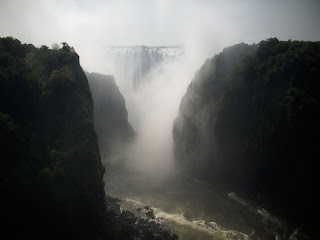
The Falls are very difficult to capture by camera in all their glory – looking up at them from below – for three reasons. First, the sheer amount of steam and condensation kicked up, even at the beginning of the dry season, obscures most views from below, even from dry land and at a distance. Second, the aforementioned water is absolutely pervasive near the lower edge of the falls: they rent large raincoats and waterproof bags for a dollar near the entrance to Victoria Falls Park, and I’m glad I took the latter because the bits near the lower falls are in a state of permanent precipitation. Third, and not least: How do you get a good shot of a waterfall that’s over a mile wide?
Just as I was getting over the sheer volume of water careening over the precipice, my mind was set reeling by another thought: When the explorer-missionary David Livingstone (http://en.wikipedia.org/wiki/David_Livingstone) first reached and explored the falls, he did so without the aid of roads or bridges. He just... walked, and boated, and tried not to fall over the edge before he moved on. He spent decades on various expeditions around Africa – including eight years “opening up” the Zambezi River, and seven searching for the source of the Nile. Noble ambitions, insufferable faults, and everything else aside... Who today, not fleeing from something at home, would have the sheer guts to attempt that kind of venture? It may be generations before that breed of man is once again called upon, perhaps to plumb the depths of outer space.
The ecology of the Falls took me off-guard. The upper section and surrounding areas are typical Zambian bush: green trees, green shrubs, green grass. But I took a trail down to the bottom of the falls, and when I got there I suddenly found myself treading on sandy river-bank with what exactly my conception of rain-forest-type jungle all around me. There were also baboons! - cute, funny, and also pretty menacing when irritated.
I only spent a day in the area – a shame, considering the money and time I spent getting there and back – but it was a day well-spent. After seeing the Falls from all angles, I watched a few folks bungee jump, walked onto the border with Zambia for the second time so far, had a delicious burger, and headed back to my hostel just in time to catch an evening river cruise. On the boat and afterwards, I finally got to meet the other three Yalies in Zambia (Yes, there were four of us, in Zambia, at the same time.), as well as a brigade of Irish medical students bent on taking full advantage of the cruise’s open bar. We all had a blast, deep into the night, and went our separate ways in the morning. By the time I got back to my dorm the next day, I was tired, happy, and broke: of the $150 I had brought with me (my stipend for the month of June), I had approximately $.25 left in my pocket.
And that’s all I’ve got for tonight; I’ll try for another update on Sunday. It’s pretty late and the internet’s been alright lately, so I’m going to try to attach a few photos as I blog via e-mail – here’s hoping it worked.
Yours,
~Ethan
A quarter of my internship, and a third of my time in Africa, is already behind me.
This week was spent translating company workflow/operating procedures for Human Resources, watching and analyzing “Rain Man” in my English class (not a big hit with my students, as it turns out), and tagging along on a few outings with co-workers (vegetable market, container pickup at the Zimbabwe border). Last night we had another delicious party: massive crayfish, shredded potatoes, boiled dumplings, and chicken and onion stew, followed by plenty of toasting and several rousing games of ping-pong. Experts agree: if Brian Jacques had spent any significant time in China, his books would have had to be banned for excessive epicurean sensuality.
The trip to the border turned out to be a lot of fun. There was a miscommunication and it wasn’t until we got there (after waking up at 5 AM in order to arrive on time) that we found out the container had already been sent up to Lusaka. It was a beautiful drive, though, and on our way back we took a clandestine detour (shh, don’t tell the boss) to Lake Kariba, the largest man-made lake in the world. The only way I can describe to you how big it is, is to say that from the mountain road overlooking the lake, it looks like you’re looking down at a bay and out across the ocean. The Kariba Dam is, as you might expect, similarly massive. I have some great photos of the froth, steam, rainbows, and general impressiveness made by the cascade of water down from the dam… and at the time we went, they had only opened one of the six gates in the dam. (Apparently on the rare occasion when the water level is high enough to warrant opening all six gates at once, the President often comes down to see.) And although the dam was originally constructed by the English, we also ran into some Chinese workers from SinoHydro (中国水电) doing expansion work on it.
Chinese companies, it turns out, are everywhere, at least in Lusaka, and are into pretty much everything industry can legally be a part of. There are so many of them that there’s a whole subset of them dedicated to providing things for the Chinese community: you can buy your favorite snacks or spices after a meal and maybe some karaoke at one of the more authentic Chinese restaurants in town; every week a guy comes around delivering high-priced Chinese-brand cigarettes; and there’s even a huge, Chinese-run “Great Wall Casino,” which I’m told is the reason behind my company’s strict anti-gambling policy.
“Made in China” takes on a completely different meaning here. Not that there aren’t cheap, low-quality goods coming in from that country – I’ve heard businesspeople and ordinary consumers alike complain about that, though some say it’s getting better. But in a country without much of a manufacturing sector of its own, it’s often just not economical to buy local. At the Chinese compounds, it’s understandable that a lot of things would be made in China – and most are – because they fit Chinese tastes, habits, and requirements. But go into the warehouses of any of my company’s three subsidiaries – machinery, department store, construction – and you’ll also find that most products, even large building materials that I imagine must be difficult and costly to transport, are imported from China. I asked about these latter materials in particular, and I was told that either they don’t make them (up to specifications) locally, or they do but it’s actually cheaper to import (probably because production is done on a small scale). I finally understand a bit better how, in a country whose standard of living and wages are clearly not equal to China’s, the cost of living in Lusaka can be significantly higher than the cost of living in Beijing.
The Chinese-Zambian relationship within the company seems, at its core, pretty strained. On the Chinese side – to which I am unavoidably biased, since I’m really not “in” with any Zambian workers – it’s mostly a question of theft and diligence. Theft is the biggest complaint, both from my co-workers and from my boss: supplies like cement and paint often go missing (so often that one of the construction company’s supervisors now lives on site), and valuables will sometimes disappear from rooms that are cleaned by local housekeepers. I have no idea whether this is accurate, but the more forgiving long-time Chinese employees have described it to me like this: “They don’t see it as stealing. It’s just taking. And a lot of them think that if they go to church the next day and confess, then it’s fine.”
The second-biggest complaint is always diligence: that local workers take thrice as much time to complete a task than Chinese workers would. I suppose that on the one hand it’s important to know that, in a country with a higher cost of living than China, the construction workers only make around 1/5 of their overseer’s salary. But I don’t think that negates all expectations of efficiency, especially in a country with sky-high unemployment – and when the tan, leathery construction site overseer tells me that he had to train all of them himself and that a Chinese crew would have gotten the new warehouse built twice as fast, I absolutely and without reservation believe him. I know his type. He came from a family with no money, quit school after the ninth grade, and worked years of day jobs, night jobs, and weekend jobs to get where he is today: spending three years living in a shack on a construction site in a faraway country, away from his wife and child, so that he can make a better wage and support his family. He is a Chinese laborer – that same, dying breed of man who built railroads in the American West in the 19th century; worked the sugar plantations of Hawaii into the 20th; built subway lines and high-rises in every burgeoning metropolis of China in the early 21st. He looks down on men who were unemployed last month and yet are already starting to show up late for work or refuse to come in on Sundays.
And that’s it for this week’s notes and observations. It’s taken me quite some time to write even these few paragraphs, and I want to start reviewing the second half of last semester’s vocabulary today.
Until next weekend.
~Ethan
This part of the story starts where the last left off, in Dar es Salaam.
My last two days of wandering the city were interesting but don’t bear a whole lot of description. Most people were in Dar to catch the ferry to Zanzibar, the predominantly Arab Muslim set of islands off the coast. So I wandered, which anyway is what I like to do best in a new city. I prowled the neighborhood; walked along the beach; decided that, sunburn notwithstanding, I was going to get completely toasted (the other kind) if I stayed out in the open for too long; happened upon the main fish market, which was bustling even late in the afternoon; ate some delicious fish, rice, & beans; met some interesting foreigners (a handful of Canadians, several groups of Scandinavians, and very few Americans; stumbled upon one of the five Chinese clinics in Dar; got lost in the auto parts/repair section of the city (this section exists) and couldn’t seem to get out; and bought provisions for the next leg of my trip – a loaf of bread, 4 liters of water, a half-kilo of peanut butter, a large package of raisins, and a few tomatoes and bananas.
Here I want to mention a happy discovery that I made while in Dar: I discovered that, after many years of refusing to eat bananas, my dislike for them has suddenly disappeared. I won’t eat them by the bunch, and I won’t rate them as delicious, but I would definitely call them an acceptable snack.
That Friday, I left my hotel for the 2-mile, hour-long trip (you read that right: traffic and terrible roads) to the Tazara Railway Station. (Tazara: TAnzania-ZAmbia Railway Authority.) I arrived at noon and had the good fortune to run into a few of those characters that one always seems to meet while traveling: a Ph.D candidate whose research topic was, in fact, the Tazara line; and a super friendly/easygoing couple (of travel partners?) from Sweden & Denmark. When it turned out that I had been booked into a compartment with three women and I was summarily kicked out, the Scandinavian couple took me in, which I’m pretty made sure the journey about three times as fun as it would have been otherwise.
The Tazara experience, was, in a word, fantastic. The company was fun. The food was good (and a lot less expensive than I had expected). The scenery was gorgeous: partly forested countryside, similar in some ways to more sparsely populated areas of New England but reaching a whole new level of greenery and vastness. Busy scenery-watching, which is made much more fun by leaning out windows or even doors, I ended up doing a lot less reading than I expected – and even by the third day, I still couldn’t get over the trees. I took a few hundred photos, but you’ll have to wait on those: the Internet here is, on average, even slower than it was in my Beijing apartment. On the first afternoon, we passed through the edge of a Tanzanian game reserve, where I saw my first (wild) giraffe, zebra, wildebeest, and impala. But I don’t have photos of any of these, because the encounters were too fleeting – and to my infinite regret, I was reading on my own and completely oblivious when we passed the elephants.
Tazara was made by the Chinese in the early 1970s – partly to rival the Soviets’ dam-building up north; partly in a spirit of brotherhood with the new socialist countries; and partly to win African backing in the UN for international recognition of the Communist Party as the legitimate government of mainland China. Traces of Chinese workmanship can be seen everywhere, if you’re looking: from the bilingual electronics controls to the plates in the dining car (they still have originals?!) to the classic Chinglish sign (also on most trains in China) informing people that they should not use the bathroom while the train is stopped: “No occupying while stabling.”
When we got to Mbeya, a few hours away from the Zambian border, the Scandinavian couple got off and I was kicked out of my compartment on grounds of taking up too much space. I ended up with a couple of Zambian businessmen who work importing luxury goods for customers in Lusaka. They struck me as a bit hypocritical (I can’t really explain this), but overall seemed to be good people, and also quite helpful. The train was delayed for seven hours the first night (something about pieces of another train on the tracks? encouraging.), so we ended up reaching our final stop, the Zambian town of Kapiri Mposhi, at around midnight of the third day.
It’s usually not very safe to go out at night in Africa. But when several of the other foreigners who had been on the train with me tried to bargain for a minibus to Lusaka (200km or so distant), the two Zambians I had been traveling with told me that it would be better to get a taxi to a bus stop and wait for the public buses passing by on their way from the Tanzanian border. I hesitated a bit but decided to throw my lot in with them. There were definitely a few hairy moments: the “bus stop” was really just a gas station where buses might or might not stop if someone flags them down, and I turned out to be justifiably nervous about the young guys hanging out by a charcoal fire outside when one of them started throwing cinder blocks at another’s head and then pulled a knife and chased him away. But the men I was with knew what they were doing – they just kind of shrugged and said, “probably a turf conflict” - and we eventually all bundled into a taxi and drove to Lusaka. At between 100-150 kph, we managed the distance in just a few wild hours, and even stopped for tomatoes at a fruit stand along the way. I slept a few hours at the house of the brother of one of the Zambians – who, as it turned out, is an insurance broker for a firm whose clients include the company I’m interning for, so it was easy to arrange for one of the company’s drivers to pick me up and take me to company HQ.
Which brings me to my life as an intern.
It’s a busy job, but not hard. This first week has been mostly about getting familiar with the company (job shadowing), translating some documents into English, and holding intermediate-advanced English classes. I’m also practicing a folk-”red song” for the 90th anniversary of the founding of the Communist Party of China, a move that’s sure to kill my 2028 run for President 17 years before it starts.
Company HQ is split into two major locations, just down the road from each other: one for the company’s agricultural machinery and department store subsidiaries, and one for its construction/contracting subsidiary. I live in the latter, which is very new and thus nicer in some ways – I have my own room, and it’s more than twice as big as the Beijing apartment I rented last semester – but lacks the homey feeling of the older one. The machinery-and-department-store area is comprised of a set of small office buildings, a machinery exhibition room, two large warehouses, and a square courtyard in the back around which the Chinese employees live. The construction company’s base of operations is a single large courtyard abutting the road, with offices on one side, 3 floors of dorms on the other, and a brickyard and warehouse in the back. There’s also a construction site further down the road, where the company is building several warehouses, a workshop, more dorms, and a villa (for the bosses).
We work from 8:00-5:00 Mon-Fri and 8:00-12:00 Sat, with an hour each day for lunch. I also give English lessons for an hour each evening, Mon-Fri. There are plenty of times when people aren’t busy – for example, there are no orders from the warehouse, or no machines need to be fixed – so the employees often have time to talk, which has been very conducive to getting to know people and coming to understand how the company works. In principle, main job over these 8 (now 7) weeks is to work on company publicity: the idea is that I take a lot of photos, capture people hard at work on video, interview happy workers and knowledgeable bosses, and eventually put together a brochure and add a lot of content to the web site, both about the company itself and the situation in Zambia. (Many potential employees back in China – and, as I have discovered, plenty of Americans as well – see all of Africa as one big, hunger-stricken war zone.) The company already has a translator, but he’s abrasive and busy and his English is far from perfect, so I’ve also been translating a few odds and ends into English when needed: a certificate of government approval for a new product being imported from China; a quality inspection report for a different product (insanely difficult), a list of job responsibilities and best practices, etc.
Socially, things are going really well. I’ve been welcomed with open arms by most of the folks here – partly because the Chinese are just friendly like that, partly because I speak enough Chinese to get along with most of them, and partly because a lot of people here have something of an “us and them” (Chinese and Africans) mentality and I seem to fit in better with the “us.” This area of Lusaka is not exactly the most thrilling of environments to be in – for safety reasons, we’re not allowed out past 9 at night, and most people just want to sit down and relax anyway – but I have my own things to do during the week (reading, watching movies, reviewing Chinese), and on Saturday nights we have Chinese-style parties, which I have to say are far superior to most similar Yale events. At our courtyard, Saturday night basically involves getting some friends together, cooking some food, cracking open a few beers, and when everyone’s had enough of talking and eating, heading upstairs to play ping-pong, Chinese chess, and mahjong. People slowly head off to bed, or movie-watching, or watermelon-eating, and we wake up on Sunday morning ready to take advantage of the only full day we have each week to go out into the town.
And that’s just about it, in a nutshell. I’ve got a lot more that I want to add, but this has already gotten quite long and I’m sure there will be time over the next few weeks to go into specifics.
Hoping that you, too, are enjoying your summer,
~Ethan


